



With beautiful landscapes, rich culture and incredible food, it’s no wonder Bali remains one of the most popular destinations in the world. Visiting the Island of the Gods is practically a rite of passage for Australians, and millions of people from around the world come every year for a taste of paradise.
Travel eSIMs you may like:

Unfortunately, where there are tourists, there are scammers. The good news is that serious crime against visitors is rare, and most people enjoy Bali without any trouble at all. The problems travellers do run into are mostly petty: a bit of sleight of hand at a money changer, an inflated taxi fare or a scooter shop claiming you scratched their bike.
None of it should ruin your trip, but it can leave a bad taste. So here are the most common Bali scams in 2026, grouped by where you’re likely to meet them, along with exactly how to avoid each one.
Arrival and Entry Scams
Some of the most profitable scams now happen before you’ve even left Australia, and the rest are waiting for you in the arrivals hall at Ngurah Rai International Airport. When you’re tired after a long flight and keen to get to your hotel, you’re at your most vulnerable, so it pays to have this part of the trip completely sorted before you board the plane. The two scams below are the ones that catch the most Australians. One costs you money online at home, the other costs you money in the first ten minutes after you land. Both are completely avoidable with a little preparation, and sorting them out before you fly also means you’ll breeze through the airport faster and start your holiday in a much better mood.
Fake Visa, Arrival Card and Levy Websites
To enter Bali, most Australians need three things: the e-Visa on Arrival, the All Indonesia arrival card and the Bali tourist levy. Search for any of them and you’ll find lookalike websites with official-looking logos that charge you a big service fee on top of the real cost, or simply take your money and send nothing.
The official prices are simple. The Visa on Arrival costs IDR 500,000, the arrival card is free, and the tourist levy is IDR 150,000 per person, per visit. Apply for the visa through the official Indonesian immigration website, and pay the levy only through the Love Bali website or app run by the Bali provincial government.
How to avoid it:
- Check that every website ends in .go.id. Anything else is not the government.
- Never pay to submit the free arrival card.
- Ignore anyone in the street asking you to pay the levy by QR code.
For the full process, see our guide to the Bali Visa on Arrival.
Airport Touts and Unofficial Drivers
Walk out of arrivals and you’ll be greeted by a wall of drivers holding signs and shouting offers of transport. Some are perfectly legitimate, but unlicensed drivers often charge several times the normal fare, especially late at night when you’re exhausted and just want to get to bed.
A related trick is the “your hotel is closed” or “your hotel is overbooked” line, followed by a helpful suggestion to take you somewhere else that pays the driver a commission.
How to avoid it:
- Pre-book a transfer through your hotel or villa, and confirm the driver’s name before you fly.
- Use the official airport taxi counter inside the terminal, which has fixed prices by zone.
- Use Grab or Gojek, and walk to the designated ride-hailing pick-up area.
- If a driver says your hotel is closed, call the hotel yourself. It almost never is.
Having mobile data the moment you land makes all of this much easier, since you can book a ride or message your hotel without hunting for airport Wi-Fi.
Transport Scams
Bali’s traffic is chaotic, public transport is limited and most visitors rely on taxis, private drivers and scooters to get around. That makes transport the biggest scam category on the island. Most drivers are honest and hardworking, but it only takes one dodgy fare or one scooter shop claiming damage to sour an afternoon. The tricks below cover taxis, rental scooters and police checkpoints. A bit of preparation, like downloading the ride-hailing apps before you fly and getting an International Driving Permit if you plan to ride, will take care of almost all of them. Keep a few small notes handy too, as drivers rarely have change for big ones.
Rigged Meters and Fake Bluebird Taxis
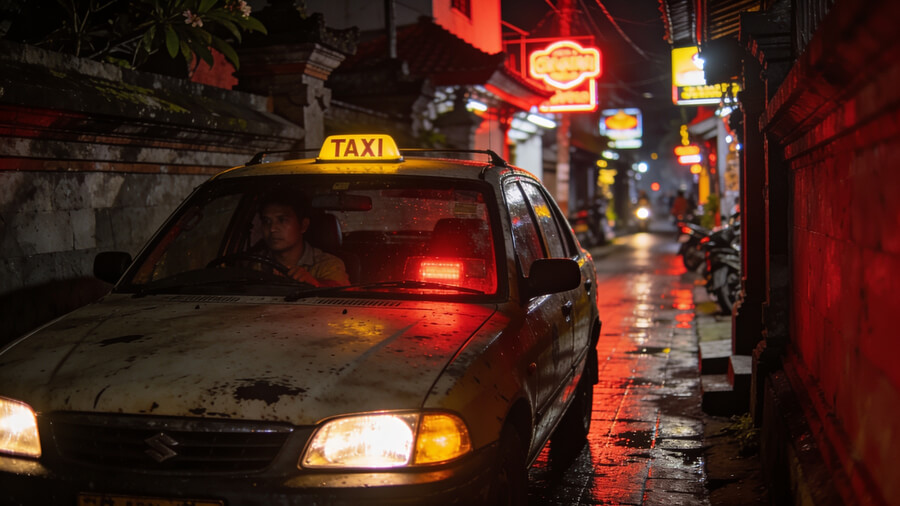
It might be one of the oldest tricks in the book, but it still catches people every day. A driver refuses to use the meter, claims it’s broken, or uses a tampered meter that ticks over far faster than it should.
Bluebird is the most trusted taxi company in Bali, and that’s exactly why there are fake Bluebirds. These copycat cars use a similar blue colour and a bird logo that looks almost right at a glance.
How to avoid it:
- Check the Bluebird name on the roof light, the driver’s ID card on the dashboard and the taxi number. Better still, book through the official MyBluebird app.
- Insist on the meter. If the driver won’t use it, agree on a price before you get in, or simply get out.
- Use Grab or Gojek, which show the price before you book.
- Know that some areas, like parts of Ubud and Canggu, have signs banning app pick-ups by local driver groups. Walk a little further away to book, or use a local driver and agree a price upfront.
The “Broken Rental Scooter” Scam
Scooters are a fun and cheap way to get around. But some rental shops make their real money when you bring the bike back.
The scam is simple. The shop points out a scratch, dent or mechanical problem that was there before you hired it and demands an inflated repair fee, sometimes holding onto your passport until you pay. In nastier versions, someone follows you and damages or steals the scooter while it’s parked, then the shop charges you for it.
How to avoid it:
- Never leave your passport as a deposit. Offer a cash deposit or a photocopy instead.
- Take a video walking around the bike before you ride it, zooming in on every scratch, and get the owner in the shot if you can.
- Rent from shops with lots of recent online reviews, or through your accommodation.
- Get a written rental agreement and keep a copy.
- Use a proper lock, and park in attended parking areas where possible.
Police Stops and On-the-Spot “Fines”
Police checkpoints are common on popular tourist routes, and they’re often set up to catch foreigners on scooters. To ride legally, you need an International Driving Permit with a motorcycle endorsement, plus a valid Australian motorcycle licence and a helmet. Many travellers have none of these.
Traffic fines are real, and Bali police do run crackdowns. But stops can turn into negotiations for cash paid straight into an officer’s pocket, with the amount mysteriously rising for tourists.
How to avoid it:
- Get your International Driving Permit before you leave Australia. You can’t get one in Bali.
- Always wear a helmet and carry your licence and IDP.
- Stay calm and polite. If you’re fined, ask for an official ticket (a tilang).
- Check that your travel insurance covers scooter riding. Many policies don’t if you’re unlicensed.
Money Scams
Bali still runs on cash, and the Indonesian rupiah has a lot of zeros, which makes it easy to get confused when counting big stacks of notes. Scammers rely on that confusion. The fixes are simple, though, and once you know the tricks, they’re easy to spot. Here are the two main money scams to watch out for, plus how to use cards safely. Before you exchange anything, check the current rate in a currency app so you know roughly what you should get back. One Australian dollar is worth around ten thousand rupiah, which makes quick mental maths much easier. Then keep these two scams in mind every time you hand over cash or a card.
Money Changer Tricks
The dodgy money changer is a Bali legend. The classic con works like this: a small booth advertises an exchange rate that’s noticeably better than the shops around it. The staff count out your rupiah in front of you, and it’s all there. Then they hand it back for one final count or to put it in an envelope, and in that moment, they palm a few notes using sleight of hand. You walk away short.
Other tricks include hidden commissions that aren’t mentioned until after the exchange, and “calculator errors” that always seem to favour the changer.
How to avoid it:
- Use authorised money changers with an “Authorised Money Changer” sign, preferably inside a bank or large shopping centre.
- Be suspicious of rates that seem too good to be true.
- Count the money yourself, and don’t hand it back once you’ve counted it.
- If anything seems off, ask for your own currency back and walk away.
ATM Skimming and Card Fraud
Using an ATM is a great way to avoid money changers, but it isn’t completely risk-free. Criminals sometimes fit skimming devices to standalone machines in quiet areas, capturing your card details and PIN.
You may also come across shops and restaurants that add a surprise surcharge for paying by card, or claim the card machine is broken and suggest you take cash out from a nearby ATM that they happen to recommend.
How to avoid it:
- Use ATMs inside or attached to banks, ideally during business hours.
- Check the card slot and keypad for anything loose or bulky, and cover the keypad with your hand.
- Turn on transaction notifications in your banking app, so you’ll know immediately if your card is used.
- Choose to be charged in rupiah, not Australian dollars, when paying by card. The conversion rate the terminal offers is usually worse.
- Use contactless payments where you can.
Tour and Attraction Scams
Bali has some incredible experiences, from sunrise volcano hikes to centuries-old temples. Unfortunately, the most popular attractions also attract people looking to cash in on visitors who don’t know the rules or the real prices. These are the main ones to watch for. Knowing the official prices before you go, and booking through people with a track record, takes the sting out of almost all of them. Here are the ones that come up again and again, from fake tours to the infamous sunglasses-stealing monkeys of Uluwatu, plus a classic street hustle in Kuta.

Fake Tours and Bait-and-Switch Excursions
In tourist hotspots like Kuta, Seminyak and Ubud, street vendors sell tours that sound amazing and cost very little. Sometimes the tour simply doesn’t exist. Other times it does, but it’s very different from what was advertised. The “private” tour turns out to be a crowded minibus, the snorkelling trip skips the reef, or the price doubles once you add “compulsory” entry fees and equipment hire.
Another variant involves a cheap or free tour that spends most of the day stopping at shops, silver workshops and coffee plantations, where the driver earns commission on everything you buy.
How to avoid it:
- Book through reputable operators with lots of recent reviews, or through your accommodation.
- Get the full itinerary, inclusions and total price in writing before you pay.
- Be wary of large upfront cash payments to street sellers.
- Tell your driver upfront if you don’t want shopping stops.
Temple Guides, Sarongs and Donation Pressure
Bali’s temples are an unmissable part of any trip, but some are famous for pushy “guides” and donation requests. At a few major sites, unofficial guides will tell you a guide is compulsory, then charge you a hefty fee at the end of the tour. Others will demand a large donation on top of the official entrance fee, or insist you rent a sarong when one is already included in your ticket.
The Mother Temple of Besakih has a long reputation for this kind of pressure, though things have improved in recent years.
How to avoid it:
- Check the official entrance fee and what it includes before you arrive.
- Buy tickets at the official ticket counter, not from people approaching you in the car park.
- Agree on a guide’s price before you start, and know that a guide is usually optional.
- Donations above the entrance fee are voluntary. You can politely say no.
Monkeys and the Sunglasses Ransom
This one is technically run by monkeys, but it’s a genuine scam. At Uluwatu Temple in particular, the long-tailed macaques have learned to snatch sunglasses, hats, phones and even jandals from visitors, then hold them ransom until someone trades them for food.
Conveniently, there’s often a local nearby who can get your item back for a small fee and some fruit. The monkeys have figured out that the more valuable the item, the better the snack they get in exchange.
How to avoid it:
- Take off your sunglasses and hat and put them in a zipped bag.
- Keep your phone securely in hand or in a zipped bag.
- Don’t carry food or plastic bags that rustle.
- Don’t try to grab anything back. Monkey bites are a real risk and can transmit rabies, so get medical treatment immediately if you’re bitten or scratched.
Timeshare Touts and Scratch Card “Winners”
Walk along the main streets of Kuta and Legian, and someone may hand you a scratch card. Amazingly, you’re a winner! To collect your prize, which might be a holiday, a phone or cash, you just need to come along to a nearby hotel or office.
What follows is a long, high-pressure timeshare or “holiday club” presentation, often lasting hours, where salespeople push you to sign up for an expensive membership with lots of hidden fees. The “prize” turns out to have conditions that make it almost impossible to claim.
How to avoid it:
- Don’t accept scratch cards or surveys from strangers in the street.
- If you do end up at a presentation, don’t sign anything or hand over card details on the spot.
- Remember that genuine prizes don’t require you to attend a sales pitch.
Food, Drink and Accommodation Scams
These scams target what you eat, what you drink and where you sleep, and one of them is genuinely dangerous. A bit of awareness is all you need, but this is the section where it pays to take the warnings seriously. The spa and villa scams will cost you money and a bit of pride. The methanol issue is different, because it can put you in hospital, so make sure everyone in your group knows the warning signs before the first round of cocktails arrives. Here’s what to watch out for.
Spa and Massage Price Switches
Bali is famous for affordable spas, and a massage for the equivalent of a few dollars is one of the island’s great pleasures. But some places lure tourists in with signs advertising very cheap prices, then present a much larger bill at the end.
The tricks vary. The advertised price might be for a 30-minute treatment rather than an hour, it might not include tax and service, or you might be upsold oils, scrubs or “upgrades” during the treatment without being told the cost.
How to avoid it:
- Confirm the full price, including taxes and service charges, before you start.
- Ask whether any oils or extras cost more.
- Check online reviews first, and choose spas that display a clear price list.
- Be wary of staff aggressively calling you in from the street.
Arak and Methanol Poisoning
This is the one scam that can do far more than empty your wallet. Arak is a traditional Indonesian spirit that’s often mixed into cheap cocktails. Legitimately produced arak is fine, but illegally made or counterfeit spirits can contain methanol, a toxic substance that has caused serious illness, blindness and deaths among travellers in Indonesia.
Methanol poisoning symptoms can look like a bad hangover at first, including nausea, dizziness, headaches and blurred vision, and they can appear hours after drinking.
How to avoid it:
- Be very wary of extremely cheap cocktails, buckets and bottomless drink deals.
- Stick to beer, wine or drinks from sealed, branded bottles.
- Avoid homemade or unlabelled alcohol.
- If you or a friend feel unusually unwell after drinking, especially with vision problems, get medical help immediately.
Fake Villa and Accommodation Listings
As Bali’s villa scene has exploded, so have fake listings. Scammers copy photos from real properties and post them on social media, classified sites or even fake websites, with prices well below the market rate. They ask for a deposit or the full amount by bank transfer, and then disappear.
When you arrive, the villa either doesn’t exist, belongs to someone else, or is already occupied by a guest who booked through a legitimate platform.
How to avoid it:
- Book through established platforms and pay through the platform, not by direct transfer.
- Be suspicious of prices far below similar properties.
- Search the photos with a reverse image search to see if they appear elsewhere.
- Be very careful with long-term rentals advertised in Facebook groups.
Digital Safety in Bali
Bali has lots of free Wi-Fi in cafés, villas and co-working spaces, but public networks come with risks. Criminals can set up fake hotspots with convincing names like “Free Airport WiFi” or a café name, then capture your passwords and banking details when you log in.
It’s not just Wi-Fi. Phishing messages pretending to be from your airline, your bank or a booking platform are increasingly common, often asking you to “confirm” a payment through a link.
How to avoid it:
- Avoid logging into banking or sensitive accounts on public Wi-Fi.
- Turn off auto-join for open networks.
- Use your own mobile data where you can. A ZenSim travel eSIM for Bali gives you a private connection the moment you land, without any roaming fees.
- Check any payment request directly in the official app rather than clicking links.
What to Do If You Get Scammed
Even careful travellers get caught out sometimes. If it happens to you, try not to panic and act quickly. Most of the steps below can be done from your phone, which is another good reason to have mobile data sorted.
Report the incident. For theft or serious scams, report it to the local police. Bali has a dedicated tourist police unit in the main tourist areas. You’ll need a police report for an insurance claim.
Call your bank immediately if your card has been compromised, and freeze or cancel it in your banking app.
Document everything. Keep receipts, take photos and screenshots, and save any messages. The more evidence you have, the better.
Contact your travel insurer as soon as possible. And if things get serious, Australians can contact the Australian Consulate-General in Denpasar, and check Smartraveller for the latest advice.
Finally, leave honest reviews. They help future travellers avoid the same trouble.
A Little Awareness Goes a Long Way
Most Bali holidays are memorable for all the right reasons, and the vast majority of people you meet will be honest, warm and genuinely happy to have you visit. Scams exist, but they’re mostly small-time, and nearly all of them can be avoided with a few simple habits.
Count your own cash. Use official websites and apps. Photograph that scooter. Keep your sunglasses in your bag at Uluwatu. And remember that if a deal seems too good to be true, it probably is.
Do those things, and you can relax and enjoy what makes Bali so special. For more tips before you go, read our guide on what to know before your first trip to Bali.
FAQs
Yes. Serious crime against tourists is rare and most visitors have no problems at all. The issues travellers do run into are mostly petty scams and overcharging, such as dodgy money changers, taxi overcharging, scooter damage claims and fake booking websites, all of which are easy to avoid once you know what to look for.
Money changer sleight of hand is probably the most common, along with taxi overcharging and scooter rental damage claims. Fake websites charging extra for the e-Visa on Arrival, the All Indonesia arrival card and the Bali tourist levy have also become very common.
The levy is IDR 150,000 per person, per visit. Pay it only through the official Love Bali website or app run by the Bali provincial government, which ends in .go.id. Any website charging more, or anyone asking for the levy in the street, is a scam.
Generally yes, especially if you use Grab, Gojek or the official Bluebird taxi app. Make sure metered taxis use the meter, check that a Bluebird taxi is genuine, and agree on a price upfront with any driver who won't use a meter.
Airport rates are usually worse than in town, but the counters are legitimate. Exchange a small amount for your first day, then use authorised money changers or ATMs attached to banks. Always count your cash yourself before you leave the counter.
Travel eSIMs you may like:
Written by
Ryan Frawley
Travel writer and serial border crosser.
I've visited more than 30 countries so far, which sounds impressive until you see how long my travel wish list still is. When I'm not chasing cheap flights, figuring out eSIMs, or getting lost in places I can't properly pronounce, I'm usually writing about travel, remote work, and how to make both a little easier.
If you've ever searched "Can I work remotely from there?" at 2 a.m., we're probably on the same wavelength.

Get amongst it
Join the community
We will reach out when we launch new products, about our sustainability projects, specials, new innovations or maybe even cool sh*t we think is inbox worthy.


